
Haskell County Arrest Warrants Explained
An arrest warrant is a judge's written order to bring a named person into court. Texas procedure usually demands a sworn complaint or affidavit showing probable cause. The document names an offense. It also names the officer allowed to execute it. Where the record sits depends on case level, since a Haskell County felony points to the 39th District Court and District Clerk, while lower-level matters may belong to County Court, JP, or a municipal court. A warrant on file says little by itself. It does not show whether it was served or whether the case has ended. Ask the issuing court for the cause number, the exact process type, and any next appearance. Haskell County posts no public sheriff name-search portal. Start with the issuing court.
Probable Cause and the 39th District Route
For a district criminal matter, call the 39th District Court coordinator at 940-864-2661 or District Clerk Cynthia Jones at 940-864-2030. These offices route district records rather than run a public warrant search, so ask for the cause number and any access limits. Haskell County's district felony and family files stay with the District Clerk. County Court records are separate, and sharing a courthouse does not change that. The District Clerk contact page lists current contacts, and the Texas Judiciary district-court directory covers district courts across the state.
Statewide statute governs arrest authority, so this is not a Haskell County warrant or court record.
Inside a Haskell County Arrest Warrant
Haskell County posts no sample warrant. Chapter 15 governs arrest warrants. Chapter 45A sets separate lower-court procedures, and the table can help you read a document; ask the clerk which fields apply.
| Defendant name or description | Identifies the person named in the judicial command. |
|---|---|
| Offense and classification | States the alleged offense and case level. |
| Cause or warrant number | Local format is not published; request the court's identifier. |
| Issuing court and judge | Shows which office controls process and recall questions. |
| Officer command and date | Directs execution and names the authority issuing the order. |
| Bond, return, and status | Ask the clerk and Sheriff to explain any amount and service notation. |
Bond amounts can change. Confirm the current figure and payment spot with the court or the Haskell County Sheriff. Search warrants are different: they authorize searches, not arrests, and Chapter 18 governs their process and post-execution affidavit access, with exceptions, in the official text.
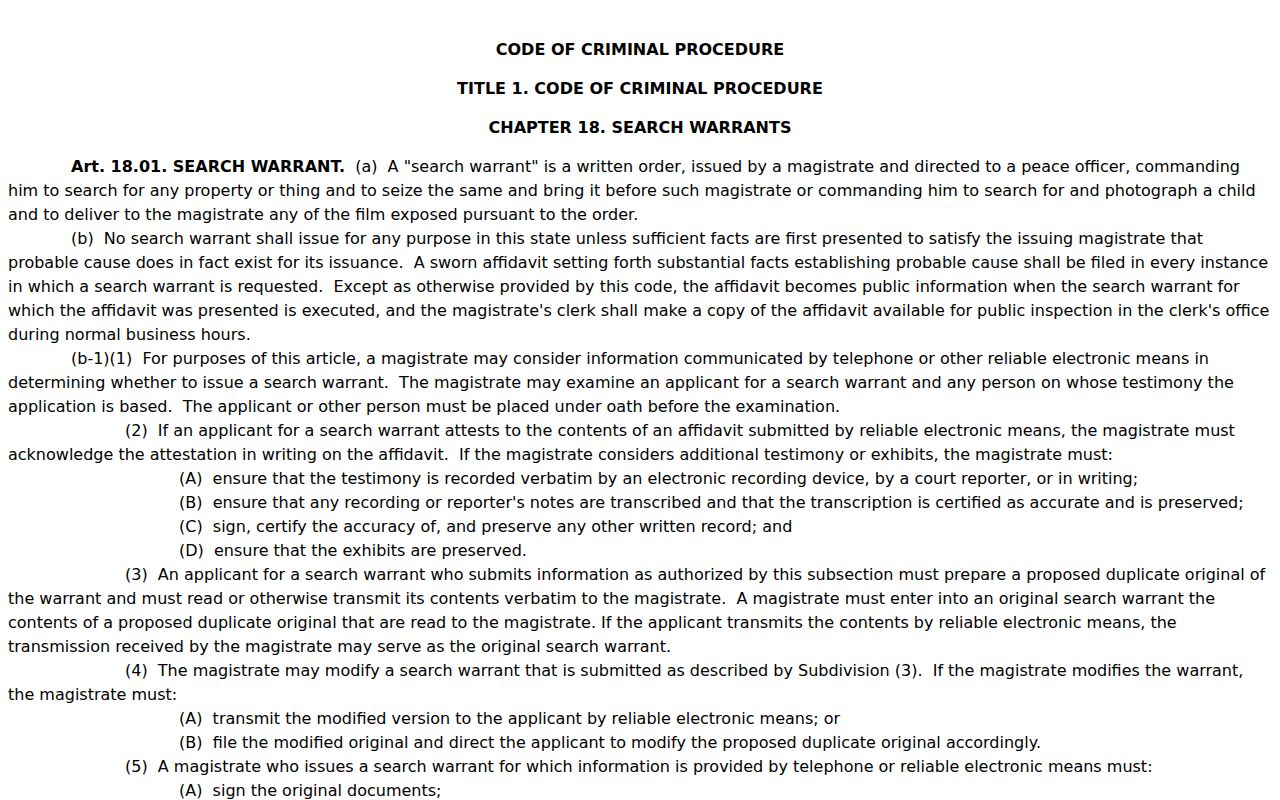
The statute screenshot concerns search-warrant procedure, not a Haskell arrest-warrant list.
Sheriff Execution of Haskell County Warrants
The Haskell County Sheriff's Office serves civil and criminal process, executes warrants, and runs the county jail. The Constable page sends the public to the Sheriff at 940-864-2345. No separate warrant-unit phone appears. The published pages list no jail street address, surrender entrance, booking hours, or bond window either. Service and custody questions go through the Sheriff. Case action belongs to the issuing court. City matters work differently. Haskell city police and the municipal court are listed separately in the city budget and court materials, though no page assigns each warrant to a named local officer. Texas law lets municipal peace officers or marshals serve certain municipal process. The Sheriff stays an official Haskell County contact. That is not the same as every city warrant appearing on a Sheriff list. Official contacts: the Sheriff's Office and the Constable page.
Serving Arrest Warrants in Haskell County
Texas law defines an arrest as restraint or custody under legal authority. A warrant can be executed any day, at any hour. The officer must make the authority known. The warrant itself must be shown on request. Those are statewide rules, and they publish no Haskell County surrender procedure. The Sheriff's page lists a courthouse contact location. It does not place the jail inside that building. A city peace officer or marshal may serve municipal process. Federal warrants run through federal authorities. The exact serving assignment for a Haskell County case is not published. If a clerk or officer confirms an active warrant, ask which office handles the next appearance and where to confirm service. Read Chapter 15 and the municipal and JP provisions in Chapter 45A.
The 48-Hour Bail Decision Rule
Article 17.028 of the Texas Code of Criminal Procedure calls for an individualized bail decision without unnecessary delay, generally within 48 hours of arrest, subject to the law's conditions and exceptions. Bail can take several forms. Personal bond, surety, cash bond, or a lawful denial all fit. That is a statewide timeline. It is not a booking schedule. Haskell County publishes no local bond schedule, warrant payment method, or jail bond window. Ask the Sheriff where custody is handled. Ask the court whether a bond has been set. And do not carry JP citation payment choices over to a jail bond. See Texas bail law and the local Sheriff contact.
The image explains statewide bail framework; it is not a local Haskell bond schedule.
Comparing Arrest, Summons, and Bench Warrants
These papers reflect different court decisions. An arrest warrant based on probable cause directs custody. A summons orders an appearance without that custody command. In Haskell County, a bench or FTA warrant usually follows a missed appearance or court obligation, and the court paper with its issuing clerk beats any secondhand description.
| Process | Usual basis | Haskell confirmation |
|---|---|---|
| Arrest warrant | Sworn facts and probable cause | Issuing court, then Sheriff for service |
| Summons | Notice to appear | Court or clerk named in notice |
| Bench / FTA | Missed setting or court order | Court that set the date |
| Capias pro fine | Unpaid judgment after required process | JP or municipal court that entered judgment |
Ask the Haskell County clerk for the exact document title, and whether a separate case, bond, or hold remains open.
Haskell County and Federal Arrest Warrants
Haskell County sits in the Northern District of Texas, Abilene Division. Federal matters belong to a court system apart from the Sheriff, the JP, and the city courts. PACER opens federal dockets to the public. A docket is still not a full warrant search. Sealed material may not appear there. For a federal question, ask the federal clerk or an attorney about the division, case number, public docket, and approved appearance route. The Abilene U.S. Marshals office handles federal service. It posts no Haskell County warrant roster. The county Sheriff cannot certify a federal matter, and a federal docket cannot clear a local JP or municipal capias. Official routing: Northern District venue page, PACER, and U.S. Marshals Abilene office.
Sealed and Juvenile Arrest Records
Public files in Haskell County can leave things out. That includes sealed warrants, juvenile records, confidential victim details, and material whose release could interfere with an active investigation. Family Code §58.010 protects juvenile warrant records and supporting complaints outright. Listed justice-system exceptions still apply. A written request can seek nonconfidential material. It cannot force the clerk to publish protected information. Ask the office what portion it can release and what law or order supports a withholding. For family, sealed, felony, or uncertain process, get an attorney's advice, and treat a missing public entry as no proof that a warrant is absent.
Access rule: Texas Family Code §58.010 limits public access to juvenile warrant records. Government Code Chapter 552 and its law-enforcement exceptions also apply to public requests.
If There’s an Arrest Warrant for You
Call the issuing clerk first. Ask whether the warrant remains active, whether bond is already set, and what action the court authorizes. A voluntary appearance, attorney walk-through, motion to recall, surrender, or bond may all be open to you. No Haskell County source promises any particular option. The Sheriff can explain service or custody routing, but only the issuing court can address its own process.
Call before going in. Haskell County does not publish a jail street address, surrender entrance, intake hours, bond window, or accepted bond payment. Confirm each detail with the Sheriff and issuing court.
Ask for the next court date. Clearing a warrant does not necessarily dismiss the case. Keep an order, receipt, or clerk confirmation, and find the separate clerk and Sheriff contacts on the Haskell County warrant overview and court map.